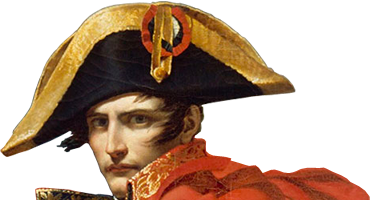
A persistent drought afflicts our lovely Shenandoah Valley, but otherwise all is well. I hope the same is true for you and yours. In my last posting I promised to relate some things I learned while working on my Ligny book. Today I want to focus on the performance of some of Napoleon’s subordinates, all of whom my readers have followed through the span of my books.
Napoleon wrote, “The first qualification in a general-in-chief is a cool head—that is, a head which receives just impressions and estimates things and objects at their real value.…The impressions he receives, either successively or simultaneously in the course of the day, should be classed as to take up only the exact place in his mind which they deserve to occupy; since it is upon a just comparison and consideration of the weight due to different impressions that the power of reasoning and of right judgment depends.” Many of the “different impressions” came from the Emperor’s subordinates. In 1815, too many were misleading or wrong.
Napoleon’s 1815 campaign strategy relied upon surprise. To deceive his quarry, he initially dispersed the Armée du Nord along a 200-mile front. On June 6, he closed the border to all civilian traffic to prevent news of his movements from being carried across the border. Then he stealthily began concentrating his forces. Even though the allies possessed an active intelligence network, Napoleon’s deception plan worked. When the invasion of Belgium began at dawn, June 15, 1815, it enjoyed near total surprise.
Napoleon’s plan called for a powerful central column to march toward the key road hub of Charleroi. A 3,800-man cavalry force supported by two horse artillery batteries led the way. Major General Dominique Vandamme’s III Corps (16,000) followed. To the left of the central column marched Major General Comte Honoré Reille’s II Corps (25,000). To the right marched Major General Count Étienne Gérard’s IV Corps (15,800). In sum, in the first wave about 60,000 soldiers converged on the narrow defile leading to Charleroi. Behind them came a second wave of similar strength, including Marshal Grouchy’s Reserve Cavalry (8,500).
It was up to the Emperor’s chief of staff to issue the orders coordinating all these marches.
When the time came to invade Belgium, the man serving as chief of staff, Marshal Nicolas Soult, failed his first important test. He had been careless in his selection of aides-de-camp [ADCs]. They were “nice young men who…need six hours to travel [six miles], get lost five times out of six, and arrive, when they do arrive, too late for any good.” Whereas his predecessor, Marshal Prince Louis-Alexandre Berthier, always sent multiple messengers to convey orders, Soult sent just one. This ADC did get lost, had a bad fall that broke his leg, and failed to find Vandamme and deliver his orders. This bungle caused critical delays. Grouchy’s Reserve Cavalry had to force march to catch up. Vandamme, Gérard, and Major General Georges Comte de Lobau’s VI Corps (10,300), which supported the central column, all got late starts. Hence, June 15 ended with Napoleon’s intended movements well behind schedule.
This proved important when an ugly jealousy arose to thwart the French thrust against Fleurus. Readers are familiar with numerous episodes of bickering senior French leaders causing problems. On June 15, a series of successful French cavalry attacks against the Prussian outpost line had filled Grouchy with aggressive enthusiasm. So, he ordered Vandamme to attack Fleurus. Previously Vandamme had been irritated by taking orders from a junior cavalry marshal and disobeyed. This time Vandamme again declined. He used the excuse that his men were exhausted.
Eventually, the Emperor sent Grouchy, with 33,000 men, to chase the Prussians and report on their movements. His initial order instructed the former dragoon general to “keep his sword in the backs” of the Prussians. His subsequent order specified, “It is important to discover what the enemy intend doing, whether Blücher is separating himself from Wellington, or whether they meditate uniting to cover Brussels and Liège by risking another battle.” Napoleon also cautioned the marshal to be cautious in case the Prussian rear guard turned to attack him. In sum, the confusing orders told Grouchy to be both aggressive and cautious. In yet another blunder, Marshal Soult failed to establish a courier line to connect Grouchy with Imperial Headquarters. This meant that there would be delays whenever Grouchy sent messages to Imperial Headquarters.
The Emperor’s exceedingly ambitious strategy relied on passing through Quatre Bras on the morning of June 16 and occupying Brussels before nightfall. Already plagued by delays, the poorly-crafted orders to Marshal Ney regarding the key crossroads, and Major General Jean Drouet, Count d’Erlon’s bewildering series of marches to nowhere (no French force exerted more influence on the Battle of Ligny than d’Erlon’s I Corps which achieved this with the majority of its soldiers never firing a shot!) put paid to Napoleon’s strategy.
The Prussian Carl von Clausewitz, who served as a corps chief of staff during the Waterloo campaign, famously wrote that no plan survives a battle’s first shot. In the past, Napoleon had a special ability to anticipate and to adjust to changing circumstance. 1815 was unique. It was the first in eighteen years in which Napoleon did not have his superb chief of staff Marshal Berthier with him. As the hours from June 15 through to the Battle of Waterloo passed, it is probable that the Emperor himself could not understand why his brilliant plans were not being executed to fruition.
James R. Arnold
August 2026